
Buying Crypto on Ledger Live Fees: What You Really Pay Before You Buy
For many beginners, buying crypto inside Ledger Live feels like the simplest option. You open the app, choose the coin, compare offers, and complete the purchase without sending funds from an exchange later. That convenience is real—but so is the confusion around fees.
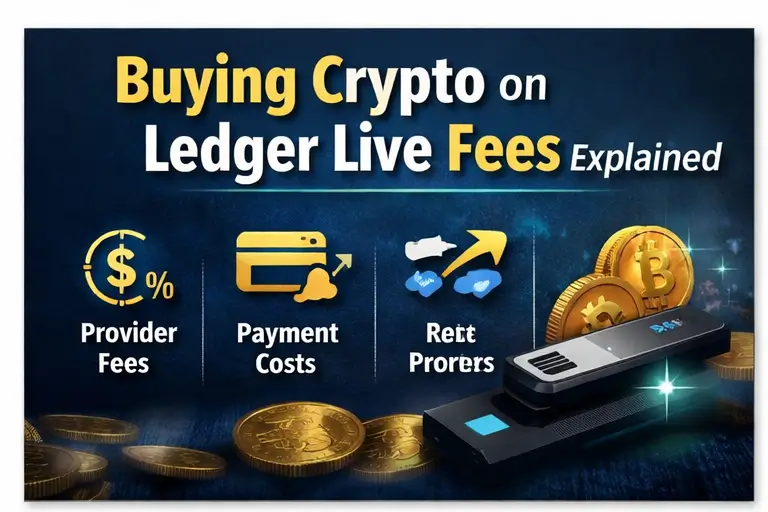
If you have ever asked yourself, “What are the real fees for buying crypto on Ledger Live?”, you are not alone. The answer is a little more nuanced than most people expect, because the total cost is not usually a single flat fee. Instead, it is a combination of provider pricing, payment method costs, spread, network conditions, and sometimes regional limitations.
In this guide, I will break it down in plain English. No fluff, no vague marketing talk—just a practical explanation of how buying crypto on Ledger Live fees actually work, what you are paying for, and how to avoid overpaying.
Quick Answer: Does Ledger Live Charge a Fee to Buy Crypto?
In practice, when you buy crypto through Ledger Live, you are usually not buying directly from Ledger itself. You are buying through one of Ledger’s integrated third-party partners. That means the fee you see is typically determined by the provider handling the transaction, not by a simple universal “Ledger fee.”
That is why two quotes for the same coin can look different even when you are using the same app. The provider, payment rail, local regulations, and market conditions all affect the final price.
Simple version: Ledger Live gives you the interface and comparison layer, but the actual buy quote usually comes from a third-party on-ramp provider.
Table of Contents
How Buying Crypto on Ledger Live Fees Actually Work
When people search for buying crypto on Ledger Live fees, they often imagine there is one published number somewhere—something like 1.5% or 3%. In reality, the cost structure is more layered than that.
When you buy inside Ledger Live, the total amount you pay may include:
- Provider fee – the service charge from the payment/on-ramp partner
- Spread – the difference between the market rate and the quoted purchase rate
- Payment method fee – extra cost depending on card, bank transfer, wallet service, or another payment rail
- Network-related cost – in some cases, blockchain conditions may affect execution or settlement economics
- Currency conversion cost – if your local currency differs from the quote currency
This is the main reason many buyers feel confused: the “fee” is often not presented as one isolated line item. Sometimes the cost is partially visible as a direct charge, and sometimes it is embedded in the quoted exchange rate.
That does not automatically mean the quote is unfair—it just means you should judge the final amount of crypto received, not only the headline fee.
What Costs Are Usually Included in the Total Price?
Let’s make this practical. Suppose you want to buy Bitcoin, Ethereum, or USDT inside Ledger Live. You enter your fiat amount and compare providers. The app shows you different offers. One looks slightly cheaper. Another seems faster. A third may support your preferred payment method.
What explains the difference?
1. The Provider’s Own Margin
Every provider needs to make money. Some do it with a clearly labeled fee. Others make the quote look cleaner but build more cost into the exchange rate. As a buyer, the result is the same: what matters is how much crypto lands in your wallet after the transaction is done.
2. Payment Method Matters More Than Most People Think
Card purchases are often faster and more convenient, but convenience usually costs more. Bank transfers may sometimes offer a better effective rate, though they can take longer and may not be available in every region.
If your goal is minimizing total cost rather than buying instantly, this is one of the first variables you should compare.
3. Country and Regional Pricing
Different countries can see different providers, different compliance rules, and different payment options. That means the quote you get in one country may not match what another user sees elsewhere, even for the same coin and the same purchase size.
4. Market Volatility
Crypto prices move quickly. During volatile periods, spreads can widen. This matters because the amount of crypto you receive can change even within a short time window. If the market is moving sharply, a quote that looked reasonable five minutes ago may no longer be the best one.
5. Small Purchases Often Feel More Expensive
On smaller orders, fixed costs and minimum processing economics can make the purchase feel less efficient. This is why a small buy may look disproportionately expensive compared with a larger one. It is not always because you are being overcharged—it is often because the fee structure has a minimum cost component.
Why Do Ledger Live Buy Quotes Differ Between Providers?
This is one of the most important things to understand.
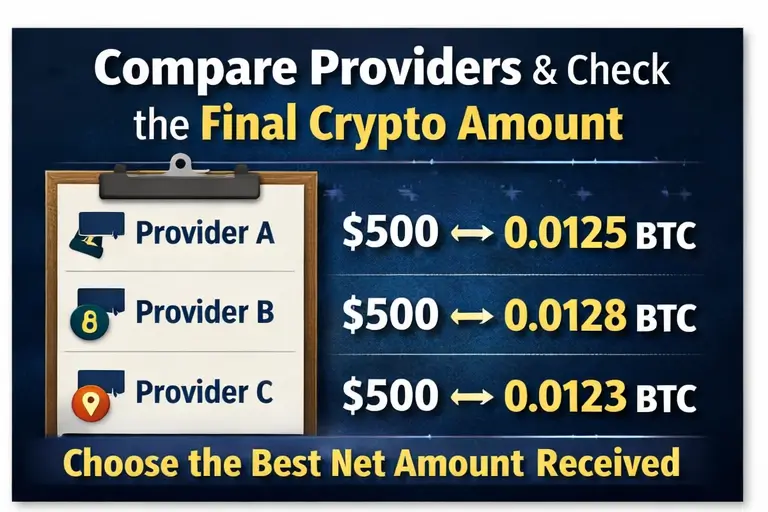
Inside Ledger Live, you are often comparing multiple third-party providers. They do not all use the same liquidity sources, risk models, payment rails, compliance costs, or pricing logic. One provider may optimize for speed. Another may optimize for broader local coverage. Another may price more aggressively on large orders than on small ones.
So when people ask, “Which Ledger Live fee is the real one?” the honest answer is: the real cost is the quote you accept from the provider you choose at that moment.
That is why comparing offers before checkout is not optional—it is one of the easiest ways to save money.
Best rule: Don’t compare fee labels alone. Compare the final amount of crypto you receive for the same fiat amount.
Is There a Difference Between Ledger Live Fees and Network Fees?
Yes, and mixing these up causes a lot of confusion.
Ledger Live buy fees usually relate to the provider and purchase flow. Network fees are different: they are the costs associated with blockchain transactions themselves.
If you are buying crypto directly into your Ledger-controlled wallet through an integrated provider, the quote may already reflect the economics of delivery. But that is not the same thing as a standard outgoing transaction fee you would manually set later when sending funds on-chain.
In short:
- Buy fee = what you pay to complete the fiat-to-crypto purchase through a provider
- Network fee = what the blockchain requires to process certain on-chain transactions
These are related to the same ecosystem, but they are not the same cost category.
Is Buying Crypto in Ledger Live Worth the Fees?
For many users, yes.
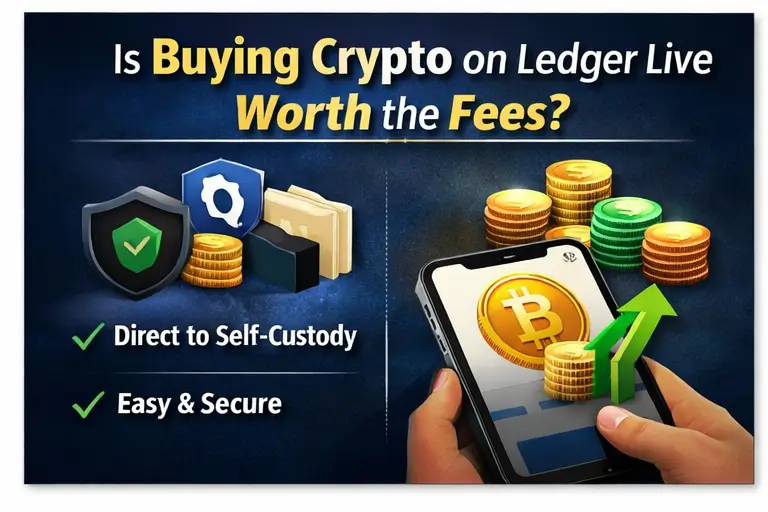
The biggest advantage is not that it is always the absolute cheapest method. The real benefit is the combination of convenience, direct delivery to self-custody, and reduced operational friction.
Think about the alternative. If you buy on a centralized exchange, you may go through sign-up, funding, order execution, withdrawal steps, destination address checks, and extra waiting. That route can sometimes be cheaper on paper, but it adds complexity and extra chances to make a mistake.
For beginners especially, there is real value in being able to buy and receive assets into a wallet environment secured by a hardware device workflow without adding unnecessary transfer steps.
So the better question is not just, “Are the fees low?” It is:
“Is the total experience worth the price for my situation?”
If you are buying a modest amount, value simplicity, and want a smoother self-custody path, many people will say yes. If you are making very large purchases and optimizing for every basis point, you will probably want to compare this method against exchange-based alternatives.
How to Reduce the Total Cost When Buying Crypto on Ledger Live
If your goal is to pay less, here are the tactics that actually matter.
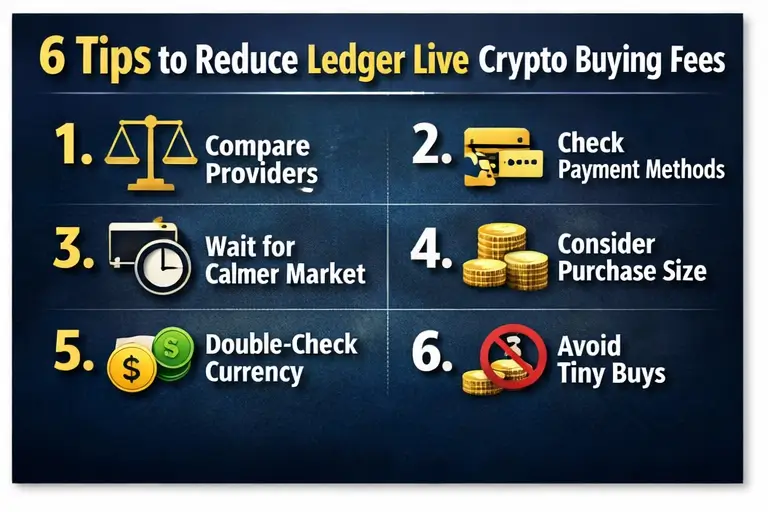
1. Compare Multiple Providers Every Time
Do not assume the same provider will always be cheapest. Pricing can shift depending on asset, amount, country, and payment method. A quick comparison can save you more than people expect.
2. Focus on the Final Crypto Received
This is the single best habit to develop. Ignore flashy labels and compare the net amount you receive after all costs. That tells you more than a standalone fee percentage.
3. Test Different Payment Methods
If both card and bank transfer are available, compare both. The slower option may be noticeably cheaper.
4. Avoid Rushed Buys During Extreme Volatility
When markets are moving fast, quotes can become less attractive. If your purchase is not urgent, waiting for calmer conditions can help.
5. Consider Purchase Size
Very small buys can feel inefficient. If your financial plan allows for it, fewer, more deliberate purchases may sometimes make more sense than many tiny buys.
6. Double-Check Fiat Conversion
If your card, bank, or payment app adds foreign exchange costs, your actual purchase may become more expensive than it first appears.
Common Mistakes People Make When Evaluating Ledger Live Fees
Mistake #1: Looking at Only One Number
Buyers often fixate on a visible fee line and ignore spread, currency conversion, or payment method costs. That gives an incomplete picture.
Mistake #2: Assuming the Cheapest Quote Is Always Best
Sometimes the cheapest-looking quote comes with slower processing, stricter verification, or less convenient payment support. Price matters, but execution matters too.
Mistake #3: Ignoring the Value of Direct Self-Custody
A lot of users compare only raw cost and forget the operational benefit of reducing extra transfer steps. Less movement between platforms can also mean less room for user error.
Mistake #4: Not Checking the Quote Again Before Confirming
Crypto markets change quickly. A quote should never be treated as permanent until you are at the final confirmation stage.
Ledger Live Fees vs Buying on an Exchange First
This comparison depends on what you value most.
| Option | Main Advantage | Main Trade-Off |
|---|---|---|
| Buy in Ledger Live | Convenience and direct path to self-custody | May not always be the lowest-cost route |
| Buy on Exchange, Then Withdraw | Can sometimes offer a better raw price | More steps, more friction, possible withdrawal costs |
If you are a beginner, the first option often feels cleaner and safer from a workflow perspective. If you are highly cost-sensitive and comfortable moving funds between services, the second route may sometimes produce a better net price.
The key is to compare the full journey cost, not just one step in isolation.
My Honest Take: What Most People Should Do
If you are new, buy a modest amount first. Compare providers carefully. Watch how the quote changes based on payment method. Learn what the final crypto amount looks like after all costs. Once you understand the flow, you can decide whether convenience or fee minimization matters more to you.
That approach is much better than obsessing over the idea of a single universal Ledger Live fee that does not really exist in practice.
In other words, the smartest move is not chasing a mythical “perfect fee.” It is understanding the structure of the purchase so you can make better decisions each time.
Final Verdict on Buying Crypto on Ledger Live Fees
So, how should you think about buying crypto on Ledger Live fees?
Think of them as a bundle of transaction costs shaped by the provider you choose, rather than one simple platform fee. The quote you see is influenced by provider pricing, spread, payment method, region, and market conditions. That is why costs vary, and that is why comparison matters.
The good news is that Ledger Live makes that comparison easier than the old “buy somewhere else, then transfer later” workflow. For a lot of users, that convenience alone is worth paying a bit extra. For others, especially larger buyers, the better choice may be using a separate exchange route and optimizing each step.
There is no one-size-fits-all answer. But if you understand what is inside the quote, you are already ahead of most buyers.
Frequently Asked Questions
Are Ledger Live buy fees fixed?
No. They usually vary depending on the provider, the asset, your country, your payment method, and current market conditions.
Does Ledger itself sell crypto directly?
In the buy flow, users typically purchase through integrated third-party providers rather than through a single universal Ledger-operated exchange service.
Why does one quote look higher than another?
Because providers can differ in fee structure, spread, payment processing cost, and regional coverage. What matters most is the final amount of crypto you receive.
Is buying crypto on Ledger Live cheaper than using an exchange?
Not always. Sometimes an exchange can offer a lower raw purchase cost. But buying in Ledger Live may reduce complexity by sending assets more directly into your self-custody workflow.
What is the best way to reduce Ledger Live buy costs?
Compare multiple providers, check different payment methods, and evaluate the final crypto amount received rather than relying on a single visible fee line.